 What Should I do with my life?
Po Bronson
The Book doesn't answer the question in its title, It can't , actually no book can. Life would be so much simpler, if answers to eternal questions like these were found in paper back novels.
The best any book can do in this regard is just to provide a few pointers or some encouragement, or maybe a prod here, a nudge there. This book does the same through examples, Examples in the form of short stories detailing incidents in people's lives when a significant change took place. Some incidents that made them think of the big questions in life?
Click here to read 10 stories in this book, very generous of Po to make 20 % of the book available free to the public on his website.
The people described in the stories are not the ones who have necessarily found their answer to the question, nor is everyone unique or what one would call or extraordinarily successful in whatever it is that they do. But everyone has in some point of time or the other saw the meaninglessness in living life and tried to find an answer to the Big question.
The book is not as much a "how to guide" but is more like a chronicle of how different people tackled this question, the difficulties they faced and the experience in general. Of course the book can't give you an answer to find your calling in life, but all it can do is to tell you that you are not alone in this quest to find out , " What should you do with your life? "
For me it just gave an idea of different experiences people have had, and he does this
He has a very interesting Blog where he writes about family, society, marriage, bringing up kids and other similar issues. Po also writes on Time.com and has an large loyal reader base who follow his blog and other writings. Marriage, divorce , and bringing up kids are topics of deep interest to him and he writes very authoritatively and interestingly on these things.
As for the book and its question. I am yet to find my answer, after all its one's own responsibility to find the answer.
PS: I like Po Bronson, for he bothered to reply to my email when I sent him a note of thanks and invited him over to Australia. Here is his reply:
Hi Hari,
You know, my UK publisher hasn't sent me to Australia to promote my books since the paperback of my first novel, in maybe 1996. I've had a few other invitations to come, but family needs have always intervened. My cousin, with whom I am very close, lives in Melbourne, and I'm working on coming sometime this coming year. His family and mine usually take a trip each year. So if that works out, my publisher has said they'll arrange a lot of publicity and events. (At least they say so). So, the end result of all this is ... maybe. Maybe I'm coming to Australia this year.
thanks,
Po
Thursday, July 05, 2007

Friday, June 08, 2007
 Book Of Questions
by Gregory Stock.
I saw this book for sale for 10 Rs(less than 30 cents Australian) on a footpath junk store in Mumbai. One of my favorite places in those cash poor times to buy books dirt cheap. Rummaging through other old books, outdated catalogues , medical journals and Mills & Boon novels, I saw this pocket sized book with an odd title which was in surprisingly good condition . A sort of a misfit among other books there, on a whim I bought this and walked on to meet another friend who was to see me in a little while.
As I flipped through its pages filled with one line questions, I knew I had picked a gem. That day on the train back home and later that night I and my friend discussed and debated the questions in this book till early hours of the morning with sleep nowhere in sight. The same pattern was to be repeated over all these years that I have had the book. It sparked so many intellectually stimulating conversations that for a long time I used to always carry it around in my backpack to read in public places, and then use the questions in it to strike up conversations with strangers.
The book as the title claims is made up of questions. Questions that will bring you closer to yourself, your ideas, thoughts, feelings, morals and opinions. This is another excellent review of the book. You can also browse through a few questions here. Have a look here to see how many people consider this book an excellent conversation starter.
I sat with an acquaintance one evening with this book and some snacks and by late night and we were friends by the time we finished the book. The same guy would then go on to borrow this book and use it to know more and get close to his potential girlfriends. I myself would eventually use this book to know more about my life partner. I have had countless exciting conversations with family members, roommates, friends, friends to be, strangers, co travelers on trains, waiting halls and in short anybody who would talk to me, all because of the book.
If there is such a thing called "ENDURING VALUE" for a book, this book has plenty of it. Of all the over 300 books that I have at my place in India this is one of the few that I chose to bring with me when I came to Australia. My only regret is that the a couple of weeks after this book I had a chance to buy "The Book of Questions: Love and Sex," again by Gregory Stock, and I didn't buy it as I was a little short of cash, and I have regretted it ever since.
Gregory Stock, If you ever read this page, Thanks for writing the Book of questions.
Friday, June 01, 2007
 What you'll never learn on the Internet
by Mark H McCormack
This is a sure fire page turner, coming from an astute business mind who actually knows what he is talking. Mark is a lawyer by profession who developed a sport stars and celebrity management business International Management Group from scratch. His company has managed the endorsements for the some of the biggest names in the international sports arena, big names such as Tiger Woods, Pete Sampras, Michael Schumacher, Derek Jeter, Charles Barkley and models Kate Moss and Elizabeth Hurley. Today IMG is the world's premier sports and lifestyle management and marketing firm, with more than 2,200 staff in 70 offices across 30 countries. I was mad about his first book What they don't teach you at Harvard business School? and picked this book up as the Author's name was familiar.
Coming from a man who actually built such a dynamic and emerging business, the book is filled with simple and totally down to earth business situations. The first few pages are spent justifying the title, as to why you cannot learn these soft skills on the Internet which is a bit of a drag but then the book gets interesting where he starts giving advice in his unique practical style.
Every thing that he suggests is based on an experience that he has had in his company. Time and again he does on about small social niceties that matter more than many bigger things. He has divided the book into chapters for typical situations in business , say if you were recruiting someone, or if you suffered a setback or a demotion at work, typical business etiquettes and office politics and communication. A lot of what he says has got more to do with managing relationships and people, but well when you think of it, isn't managing a business all about managing people ?
As for the book in general, it lives up to its somewhat odd skewed title this is indeed stuff that you could never learn on the internet(unless of course pirates put an copy of this book online;-)).
Friday, May 25, 2007
 Piercing : a modern anthology
by Housk Randall
What is the first picture that comes to your mind when you hear Piercing , a pierced earlobe ? nose ? ear rim? navel ?
Well there's more to it than I ever thought, there are piercings for the penis, its head(Yes right a hole through the head of the penis) , foreskin, Labia, clitoris, nipples , scrotum , lips, tongue, chin, eyebrows, testicles and practically anywhere ever else on the skin.
This book is a pictorial , meaning it is full of excellent photos of people with the strangest of piercings imaginable accompanying with their own description of how they got initiated into piercing. How it eventually became an addiction in these people so much so that they wouldn't feel complete with these accessories.
What struck me the most in this , and partly the reason why I picked this book is the kinds of people and the reasons why they do piercings. I mean there were a fair share of goths, and maniacs with crazy spikey hair. But many were typically mainstream whom you would never ever doubt, for example the 55ish looking accountant , buttoned up in a 3 piece suit. You would wonder what he is doing in a book like this until you look further down to see his zip open and see him proudly displaying his pierced pecker. Or the pretty Pakistani born Designer in London, who started piercings from the bottom up (meaning starting with the clitoris, Navel , and went on to pierce her lip and nose).
There were people whom you wouldn't ever doubt of doing something this naughty unless you see them here, obviously in delight with the thrill of hiding a secret, of being a vixen in sheep's clothing. This is what drives so many mainstream people into piercing. Nowadays of course it is so common that piercing is loosing its edge as a point that made people stand out. As one of the people in the book said. "These days everybody and their mother has their nipples pierced"
Looking at all the reasons why people did piercings and subjected themselves to so much pain, the only common reason I could conclude was they wanted a feeling of difference from the normal, trying to be and do something different. As for the book, it is pretty graphic not the sort of the book you would want lying on the coffe table with kids around, but definitely worth a look at other times.
Friday, May 18, 2007
 Moeibustrip - digressions from India's Highways
by Giti Thadani
For those to whom the title of this book sounds unfamiliar, Moeibustrip or rather Moeibus strip , is a strip of paper with neither a beginning nor an end.
And it is in a way apt for this book, because this book is not just an account of traveling on India's roads. This book is more about metaphysical aspects of such a journey undertaken by Giti Thadani. I loved the tagline for the book "Digressions from India's highways" wow what a lovely phrase, because that is essentially what the book is.
It follows Giti's travels on road in her 4WD gypsy, to far off places , temples in ruins, archeological sites, museums and everything in between. In fact, I hardly found any "normal" tourist places in the book, apart from The Khajuraoh temples. Giti quite naturally hates the tamasha that that goes on in typical Hindu temples and goes to depths on this topic, explaining each and every little nuances of the Brahmins and their ploys to swindle money. She also delves in deep explaining various bits and parts of stories in Hindu Mythology and the metaphysical meanings of the rituals and traditions, some one completely unfamiliar with the Hindu pantheon might not find this very interesting.
From the book it is obvious that Giti has a extraordinary interest in Etymology, and she is very good at it. The book is liberally sprinkled with Sanskrit words and explanation of their etymological origins and their meanings. These pages were all the more interesting for me as I hope to some day be proficient in Sanskrit and understand the language which according to many sources is one of the most Etymologically structured and object oriented languages of all time. I just loved some of the Sanskrit words that she explains in her book. for exp
rit = pulse of life, its throb
M + rit = death, M (indicates reversal of the meaning) Mrit
A + mrit = eternal, elixir (a indicates negation)
S + mrit(i) = Memory (s indicates preservation, keeping alive)
yog = fusion
ini = female ending
yoni = vulva, origin , waterfall, cave , source
Maheshasur derived from Mahesh = Maha or great, ish = god , asur = demon
Feminine/ Masculine : Kali / Kal (without matrika / vowel i) , Shiva / Shiv (sh(a)v - corpse - without a), Krishna / Krishn, Kumari / Kumar
The book is filled with metaphors, so much so that at times the you loose track of the real passage imagining the metaphor. Apart from this there are hundreds of words there which are either in Hindi, or colloquial in use that some one with limited exposure to Indian culture / Hindi would have difficulty in understanding. Fortunately that was not the case with me :) There are also many passages devoted to Giti's personal life , her family and experiences, which are just as interesting as some of the places she describes.
To conclude the book is more close to a writeup on Indian present day culture / life than it is to a travelogue.
Friday, May 11, 2007
 Who we are - A miscellany of the New Australia
David Dale
The cover of this book shows a map of Australia with a pair of worn out slippers. In many ways an international symbol for the Aussie Backpacker.
I love statistics and numbers especially when they are presented in a way that makes sense, and this book is filled with such interesting titbits and pieces of information that help us decipher "Australia"
For exact statistics on any topic about Australia have a look here > the website of the Australian Bureau of Statistics. This is where most of the info in this book is sourced from.
The Book is full of numbers and percentages, on topics right from Population to demographics to languages spoken , religion, qualification , smoking habits , to cars , credit cardsdiseases, causes of death, top products used in households, most popular movies, books, music, world records, important dates, animals, inventions , periodicals and every other thing that matters.
To present some interesting numbers from the book,
85% of Australian population lives within 50 Kilometers of a beach ,
1% of Australian population lives on a Farm,
43% of the all marriages are likely to get Divorced
87% of the population are Mobile owners
60% use the internet at least once a week
75% live in a home with three or more Bedrooms
Newzeland , China and India are the biggest source of Migrants Now More info on this here
Cancer Causes 29% of all deaths in Australia.
Apart from plain numbers , there are good facts about Australia, like the defining moments in Australia's history, Important speeches, national anthem etc. There is also a small essay where the author describes a typical day in the life of an Australian family in terms of the products they use.
In all its a very good read and gives a quick snapshot of Australia as we know it.
Friday, April 27, 2007

Spotted in France
by Gregory Edmont
 Notes from a Small Island
By Bill Bryson
Saturday, March 31, 2007

by Stephen Clarke
I found this book about a Brit's impressions on life in Paris, very very entertaining, Its a genuinely laugh out loud kind of a book with written in style by Stephen Clarke under the pseudo narration by a character Paul West. For those who don't know Merde is not the name of some posh suburb but actually is the french translation for "Shit"
I picked it up because it promised humour starting from its cover, the back cover said "A Year in the Merde is an almost-true account of things that may or may not have happened to him in the ten years he has lived in France, depending on who is asking the question. He originally published the book in an edition of 200 copies, with the intention of selling them through his website, giving them away to friends or offering them as fuel for his neighbour's Bastille Day barbecue."
Well I can't really write anything better than what has been written about this book in so many places, to get the hang of the storyline see this or go here to read a better informed review on the book.
For my part I just enjoyed the book thoroughly, the way he takes potshots at the French and their language , work(or actually Strike) culture and their little idiosyncrasies. For someone like me whose idea of night life is a good book or some good company , he paints a good picture of the hot an happening night clubs in Paris and his sexual misadventures. In all I found it immensely entertaining and can be a good read if all you are looking for is a hearty laugh.
Saturday, March 03, 2007
 In a Sunburned Country
by Bill Bryson
This book was given to me by an American friend; I mention this because the book is not available in the said title outside America,
My friend said it’s a very good travelogue about Australia and anyone new to Australia should read it, so he read it and handed over to me to read it. I looked up Bill Bryson online and found that he was an American, Frankly speaking, I was a bit let down when I learnt that the author “Bill Bryson” was an American, In fact the last time I had seen his travelogues in the library I did not pick them. After all Americans in general aren't really known for their knowledge and appreciation of world culture and history. Have a look here to see what I mean. I have tried hard to get rid of my set prejudices about America, as none of the Americans I have met personally are the snobbish; I am better, richer and hence better than you types. Every American I have met personally has been polite, friendly and fairly knowledgeable about external affairs, but the stereotype still remains. I guess it’s just that the country as a whole that displays that rude image but individually the people are just as just as likeable as anywhere else.
Anyway now coming back to the book , I started this book with a strongly biased viewpoint and Bryson was initially living up to my expectations, of Americans being snobby , self centered, and indifferent to the rest of the world, have a read through his first chapter here and you will see why. He starts the book saying how he again forgot who Australia's prime minister was and telling us how little Australia matters to America and hence to the rest of the world. Saying that the Australian Economy is about equivalent to Illinois and that China grows its population by about 1 Australia every year. He gives statistics explaining the abysmally small number of articles about Australia that appeared in the American media in the past few years. And By taking the number of articles in newspapers as a benchmark for importance, he says Australia is about as important to Americans as Bananas but not nearly as important as Ice-cream. And Imagine reading all this in the first 2 pages with the prejudices I have, it was just getting enough for me to put the book down.
Well , luckily for me I did not put this book down then because he tries to highlight this as an issue to put things in perspective, to highlight where "Australia" stands in American minds as a subject. He exhorts the reader that things shouldn't be this way because he finds Australia a lot more interesting than what is currently projected outside. The next few pages are devoted purely to tell us why Australia is so much more interesting than the media would have us think. He mentions so many interesting facts about Australia that I doubt even a lot of Australians wouldn't know of. Say for example facts about the Australian Wild life , Did you know that, of the 10 most poisonous snakes in the world all the ten are native to Australia, There are has more things in the Australian wilderness that can kill you than any other place on the earth. 80% of all the wildlife that exists in Australia is so unique to itself that its not to be found anywhere else on the planet. Australia is a place so arid, so flat , so hot and so deserted that there is no other place on the planet except Antartica that is perhaps more forbidding to life, in spite of this, it has perhaps the largest inhabitation of yet to be discovered species of insects, animals and wildlife anywhere in the world because it is so huge that there are just not enough scientists / biologists around to cover it all. He made such an interesting case for Australia that I had shed all my initial inhibitions and in the first few pages was glued to the book.
From there on the book follows his journey across Australia, by train, car and on foot. Bill can be incredibly funny when he wants to be and there are so many moments where you can literally laugh your heart out on the incidents he narrates. He goes on describing his stay in Sydney , Melbourne, various other road trips and train ride on the INDIAN PACIFIC RAIL ROAD (Called so because it reaches out from the Indian ocean all the way to the Pacific ocean) running across Australia connecting Sydney on the east coast to Perth on the west coast across over 4000 kilometers, second only in length to the Trans Siberian railway.
The book has a lot of history about Australian Exploration starting with James Cook(the first western sailor to land on Australia in recent history, for the record he was a Lieutenant not a Captain when he discovered Australia), and then going on about other explorers who dared to go into the arid inland, he gives us detailed accounts of their experiences and what they found and faced in the Australian “Outback”. He writes about various other Australian adventurers like Kingford Smith and people and incidents in contemporary Australian history.
He covers all the major Australian cities, starting from Sydney, Canberra (ACT), Melbourne, Perth, Alice Springs, Darwin and many other smaller towns and paints an interesting picture of each of them. He also does long road trips across the outback and the coastal roads in Australia.
Frankly speaking I haven't read a better travelogue than this ever. Mind you this is not a book with lists of places to / see / eat / buy stuff. This book is about seeing Australia through Bill Bryson's eyes. Reading it is like experiencing the country for yourself and doing a short course on Australia with hard facts and detailed glimpses into Australian History, Geography, Botany and even some current affairs.
Then he tells us about the stolen generation and goes to depths devoting many pages to the cause of the Aboriginals and the injustice that was done to them in the past, the book has indeed a very poignant description of the atrocities done upon the Aboriginals. Since this is a shameful part of Australian History like the White Australia policy that you don’t read or hear a lot about it, so this makes it even more interesting.
Towards the end there is an Appendix with about 10 articles that Bill wrote for the Sydney Morning Herald, while he was invited over to cover the Sydney Olympics in 2000. These few pages are like a bonus to an already very interesting book, and are good read by themselves.
The Book does not have any photos within its pages, only 2 pages of rough maps showing the route taken by the author. For me this is a big thing in itself as it’s the first travelogue book that I have read without even a single photo. It shows that the author doesn’t need the photos to lean on to help the reader visualize what he describes.
In all I have to agree with my friend who gave the book to me and said, "Any visitor to Australia MUST read this" and I AGREE!
Hats off to Bill Bryson.
Friday, December 08, 2006
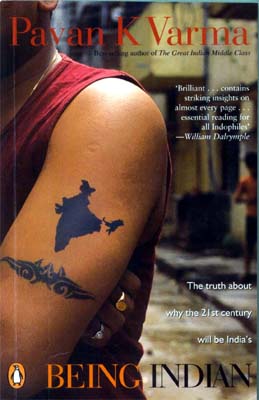 Being Indian
by Pavan K Verma
"Ethos" as per the dictionary means "the distinctive spirit of a culture or an era" and the Indian ethos is what this book is all about. A true feast for Indians and foreigners alike, this is a must read for anyone interested in the Indian culture. The book describes precisely the inner workings of an Indian mind, why the Indians are the way they are?
I haven't read anyone else describing an abstract concept like "Indian ethos" so very well. The book is filled with anecdotes and accounts of various glaring contrasts and contradictions that make India.
The Author, Pavan K Verma was High Commissioner for India in Cyprus and has held other assorted positions in the Indian Diplomatic service. Coming from such a very learned man of such high social standing the book is surprisingly down to earth. When you read, It becomes obvious that the author has had his ears very close to the ground. Personally I liked the book and I recommend to any one who seems interested / curious about Indians.
Best of all , I had written a small mail to Pavan, generally thanking him for writing the book, and he was courteous enough to reply back. I got a reply the very next day :
thank you hari for your appreciation for my book. i wrote as honestly as i could, and i am glad some people have liked what i have said. we shd certainly try and meet when i am next in mumbai or pune, best, pavan
Now this might seem a small thing , but well I am impressed. By the book and by the Author.
Hats off to you, Sir!
